Multi-Entity Groups
One platform for every entity.
One close for the whole group.
Intercompany settlement is the #1 bottleneck in multi-entity close. Axiomatic replaces the spreadsheets, email chains, and manual matching with a structured protocol — entities propose, confirm, and settle transactions with matching entries posted to both ledgers simultaneously. IC eliminations flow through automatically at consolidation.
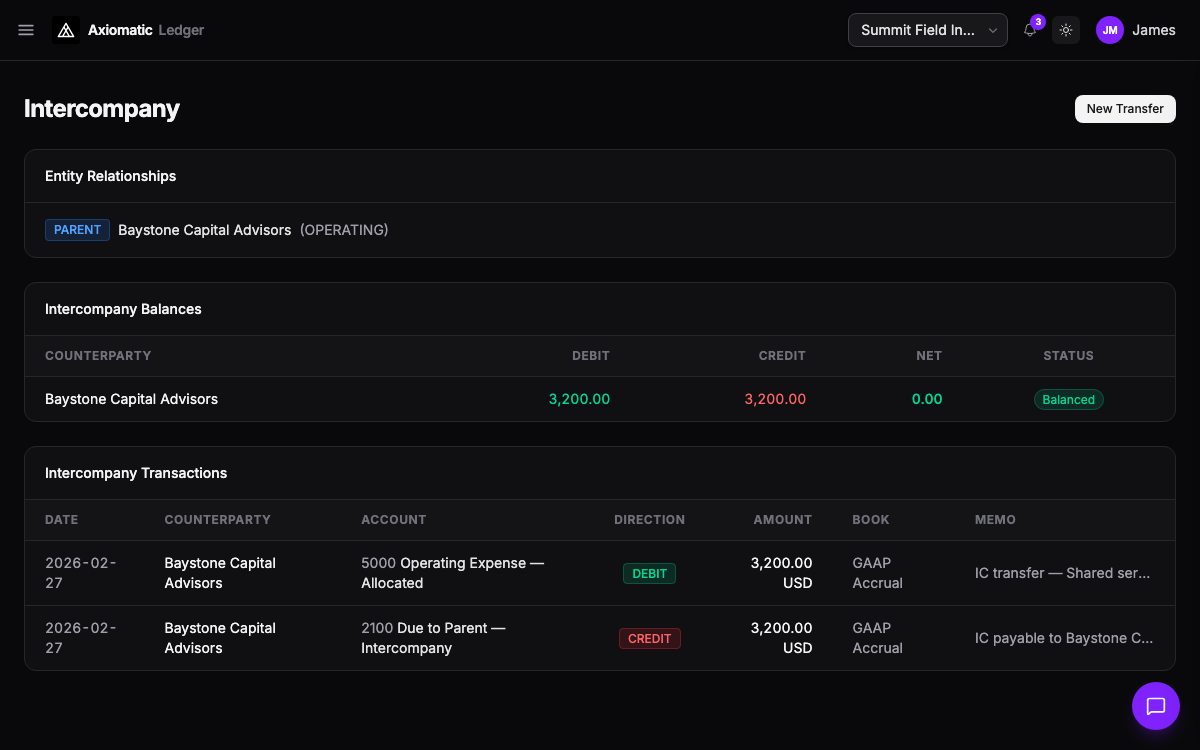
Consolidation shouldn't be a fire drill
Every quarter, your team manually matches intercompany balances across entities. Someone exports a trial balance from Entity A, emails it to Entity B, and waits for confirmation. Differences get tracked in a shared spreadsheet. Elimination entries are keyed by hand. One wrong number cascades through the consolidated statements.
Axiomatic eliminates this entire workflow. Intercompany transactions are settled through a structured protocol that posts matching entries to both ledgers at once. When you consolidate, IC eliminations are automatic. The consolidated close takes hours, not weeks.
Structured intercompany settlement
A three-step protocol that replaces email chains and shared spreadsheets with tamper-proof, simultaneously posted transactions.
Propose
One entity initiates the intercompany transaction — a service charge, cost allocation, or internal sale. The proposal is locked against modification and visible only to the counterparty entity.
Journal entry
DR Inventory / CR Accounts Payable
Accept
The counterparty reviews, verifies, and approves. Both entities maintain independent books throughout — no shared spreadsheets, no email chains, no manual coordination.
Journal entry
DR Accounts Receivable / CR Revenue
Finalize & Settle
Once both sides agree, matching journal entries post to both entity ledgers simultaneously. IC elimination entries are generated automatically at consolidation. The settlement is permanently recorded and verifiable.
Journal entry
DR Cash / CR Accounts Receivable
Everything you need for multi-entity accounting
Automatic IC elimination
Intercompany balances and transactions are tagged at the point of settlement. At consolidation, elimination entries generate automatically — no manual matching, no missed eliminations.
Consolidated financial reporting
Roll up trial balances, balance sheets, and income statements across every entity in the group. Currency translation, minority interest adjustments, and proportional consolidation built in.
Multi-book per entity
Each entity can maintain GAAP, Tax, IFRS, and Management books independently. Consolidation works across any book type — or across different standards.
Role-based access per entity
Entity controllers see their entity. Group controllers see everything. Auditors get scoped, time-limited access. Permissions are granular to the entity, book, and account level.
Period management across the group
Close calendar with per-entity status tracking. See which entities are closed, which have pending IC transactions, and what's blocking the consolidated close.
Proportional consolidation
Consolidate joint ventures and partial-interest entities at their ownership percentage. Configurable per subsidiary with automatic proportional roll-up.
Verifiable consolidated statements
Generate proofs that your consolidated financials are mathematically correct — from every entity's trial balance through elimination to the final consolidated statements.
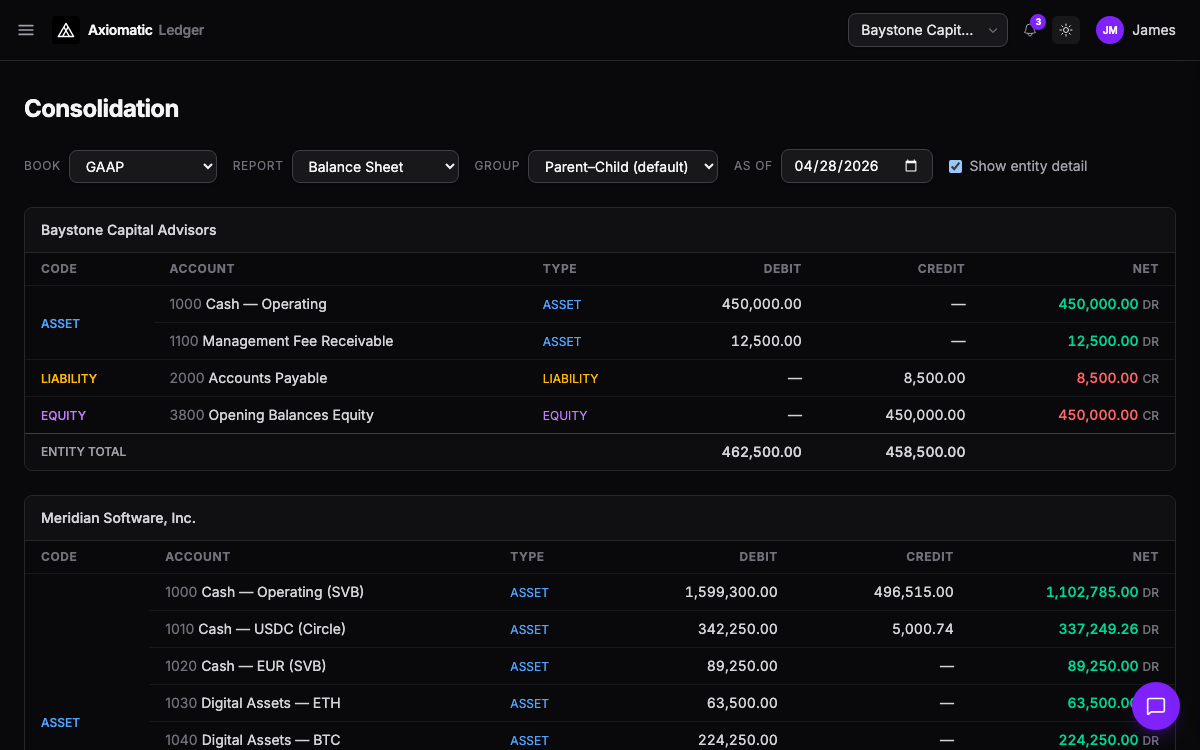
Consolidated Balance Sheet — multi-entity roll-up with entity-level drill-down
50+
Entities on Business plan
Unlimited
Books per entity
Automatic
IC elimination at consolidation
Ready to simplify your multi-entity close?
We work with you to onboard entities as you grow — no big-bang migration required.
Want our team beside you for the first 30–90 days? See guided rollout →